
A Product Demonstration, Not Just a Message
Airwallex has launched a digital out-of-home campaign that uses live foreign-exchange movements in the creative. In the announcement, oOh!media says a custom connection links Airwallex's FX platform to its digital assets, allowing the advertising content to update as rates move. The campaign is aimed at business audiences and is supported by short-form client testimonials and case-study content in office and business-lounge environments.
That makes the campaign more interesting than a standard financial-services screen execution. The changing rate is not a decorative animation around a static claim. It is a visible demonstration of the kind of information the product handles. For a business that manages international payments or currency exposure, the relevance is immediate: the subject of the creative is also part of the product experience.
The campaign does not mean live data is automatically the right answer for every advertiser. It does provide a useful test for any brand considering dynamic DOOH: does the changing signal make the product proposition easier to understand, or is it just more movement on a screen?
What the Campaign Uses
| Campaign Element | Role in the Execution | Why It Matters |
|---|---|---|
| Live FX movements | Turns a current market signal into the main creative device | Demonstrates a real product context rather than relying only on a claim |
| Digital OOH network | Lets the message update without replacing a printed execution | Supports timely creative when the data is useful to the audience |
| Office environments | Reaches professionals during the workday | Matches a business product to a business decision context |
| Business lounges | Adds a longer-dwell environment for testimonials and case studies | Creates room for a deeper product story than a fast roadside view |
| Custom integration | Connects the approved data source to the media delivery system | Requires operational ownership and a reliable fallback plan |
Why Context Is Doing the Work
Foreign-exchange data has meaning only for people who have a reason to care about it. The campaign's placement logic is therefore as important as the technology. A business audience in an office or airport lounge is more likely to connect a moving rate to international operations, payments, travel, or financial decision-making than a general audience on an unrelated route would.
This is the transferable planning lesson. Dynamic creative should begin with an audience moment: what is a person doing, considering, or experiencing in this environment? For a travel brand, live flight or weather information may be relevant near an airport. For a retailer, a localized availability cue can be relevant near a store. For a business platform, a market, logistics, or event signal may work in business environments. The data has to support the audience's interpretation of the product in seconds.
BM Outdoor's guide to billboard locations explains the underlying discipline: a placement should be evaluated by its audience, approach, visibility, and relationship to the decision, not only by how large the screen looks in a media plan.
Live Data Needs a Clear Creative Hierarchy
When a number changes on a screen, it naturally attracts attention. That attention does not guarantee comprehension. The viewer still needs to recognize the brand, understand what the data represents, and connect it to a benefit. If a live feed is visually dominant but the product relationship is vague, the campaign can become an interesting display with little commercial meaning.
- Keep the brand identifiable: the viewer should not need several exposures to know who is speaking.
- Explain the signal in plain language: a rate, count, price, score, or forecast needs a short contextual cue.
- Show the product connection: use the data to demonstrate the capability the advertiser wants remembered.
- Design a safe fallback: a delayed feed, market closure, or technical issue should never leave incomplete or misleading creative live.
Those rules apply even when the screen has animation, multiple messages, or a large dwell audience. The billboard design guide remains relevant because the viewer still has limited time and a crowded visual environment.
What a Brand Must Decide Before Buying Dynamic DOOH
A live-data execution should be planned as both a media project and a content-operations project. The media team needs availability, audience, screen specifications, proof of play, and delivery rules. The product, technology, legal, and brand teams need to agree on which data may appear, how often it changes, what validation happens before it reaches the screen, and who is responsible when a value is unavailable.
| Decision | Question to Resolve | Planning Risk if It Is Ignored |
|---|---|---|
| Data source | Is it authoritative, licensed where needed, and stable? | Incorrect or unapproved information in public creative |
| Update rules | How often should content refresh, and during which hours? | Updates that are too frequent to read or too slow to feel relevant |
| Fallback asset | What displays if the live feed fails or the market is closed? | Blank, stale, or confusing screens |
| Creative approval | Which elements are pre-approved and which vary automatically? | Late delays or compliance problems |
| Measurement | What behavior should the campaign influence? | A technically impressive execution without a business scorecard |
Where This Model Can Transfer
Airwallex's use case is specific: global businesses can see a moving FX signal and understand why it matters to a financial platform. Other categories should not copy the execution literally. They can use the same logic.
A logistics brand might use relevant shipment or route conditions only if the message remains useful and approved. A sports or entertainment promoter may use an official countdown or schedule to make an event feel immediate. A restaurant could use daypart creative, but only when the core offer remains clear. A destination brand can adjust messages for a local travel context. The shared standard is that the content must be useful enough to justify the operational complexity.
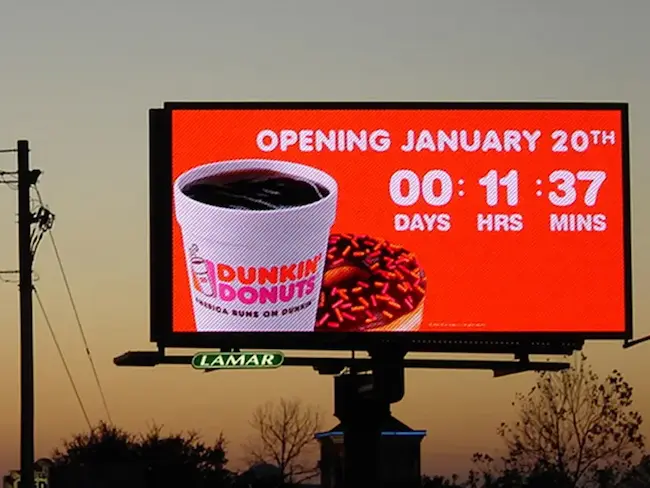
Digital billboards are not the only option. A campaign may combine a dynamic hero execution with static bulletins that deliver enduring recognition, or with transit and place-based media that create frequency in the right routines. Read BM Outdoor's digital versus static billboard guide for the core tradeoffs.
Measure the Business Question, Not the Novelty
Proof that the live feed updated is a technical check, not a campaign outcome. For a B2B campaign, the scorecard may include verified delivery, branded search, campaign-page visits, event registrations, target-account activity, sales-team feedback, qualified traffic, and pipeline influence where measurement is available. The metric mix should reflect whether the campaign is introducing a category, building credibility, supporting an event, or driving a defined action.
It is also useful to distinguish the impact of the dynamic element from the impact of the media environment. Test markets, creative rotations, time windows, or complementary digital activity can help a team learn whether the live signal improved relevance. BM Outdoor's OOH ROI measurement guide outlines how to build a practical scorecard around a media objective.
The Practical Takeaway
Airwallex's campaign is a strong example of dynamic DOOH used as product proof. The media works because the live information, audience environment, and product benefit point in the same direction. Brands considering a similar approach should start small enough to validate the data workflow and creative comprehension, then scale only when the changing content clearly improves the campaign's commercial role.
BM Outdoor can help brands evaluate current digital OOH options, locations, creative requirements, and the supporting formats that build frequency around a dynamic campaign. Request a digital OOH media plan for a campaign built around your audience and operating requirements.
Sources
- Airwallex transforms Out of Home advertising with live FX data for business audiences. oOh!media, August 13, 2026. Campaign announcement and execution details.
Ready to advertise outdoors?
BM Outdoor plans, buys and prints OOH campaigns across all 50 states. Request a free quote with no commitment.
Frequently asked questions
What did Airwallex do in its live FX OOH campaign?
According to oOh!media, Airwallex used a live connection to its FX infrastructure to update digital out-of-home creative as exchange rates moved. The campaign also used short-form testimonials and case studies in office and business-lounge environments.
Why is live data useful in digital out-of-home advertising?
Live data can make a message more timely when the data is relevant to the product and the audience can understand the change immediately. It should demonstrate a real benefit rather than add motion or complexity without a purpose.
What audiences fit a live-data DOOH campaign?
It is most useful where a current signal affects the audience's work, travel, buying decision, or daily routine. Office districts, airports, transit, retail, and event environments can each work when the data and the decision context align.
Does every digital billboard campaign need a live feed?
No. Scheduled creative is usually the better choice when a campaign has a stable message. Live feeds add operational, approval, and quality-control requirements, so they should be used only when the changing information materially improves the message.
What should a brand test before using live creative?
Test the data source, update frequency, fallback creative, readability, approval rules, time zones, legal review, and who owns monitoring. The screen should remain accurate and clear even when the feed is delayed or unavailable.
How can B2B DOOH be measured?
Measurement can combine verified delivery with campaign-page traffic, branded search, account engagement, event registrations, sales outreach response, qualified visits, and business outcomes. The scorecard should reflect the actual role OOH plays in the buying journey.
Frequently Asked Questions
According to oOh!media, Airwallex used a live connection to its FX infrastructure to update digital out-of-home creative as exchange rates moved. The campaign also used short-form testimonials and case studies in office and business-lounge environments.
Live data can make a message more timely when the data is relevant to the product and the audience can understand the change immediately. It should demonstrate a real benefit rather than add motion or complexity without a purpose.
It is most useful where a current signal affects the audience's work, travel, buying decision, or daily routine. Office districts, airports, transit, retail, and event environments can each work when the data and the decision context align.
No. Scheduled creative is usually the better choice when a campaign has a stable message. Live feeds add operational, approval, and quality-control requirements, so they should be used only when the changing information materially improves the message.
Test the data source, update frequency, fallback creative, readability, approval rules, time zones, legal review, and who owns monitoring. The screen should remain accurate and clear even when the feed is delayed or unavailable.
Measurement can combine verified delivery with campaign-page traffic, branded search, account engagement, event registrations, sales outreach response, qualified visits, and business outcomes. The scorecard should reflect the actual role OOH plays in the buying journey.
Ready to advertise outdoors?
BM Outdoor plans, buys and prints OOH campaigns across all 50 states. Request a free quote with no commitment.










Comments
Be the first to comment.